Quantum science with polyatomic molecules
Our work on conveyer-belt MOTs and characterizing collisions of polyatomic molecules is featured in Physics magazine.
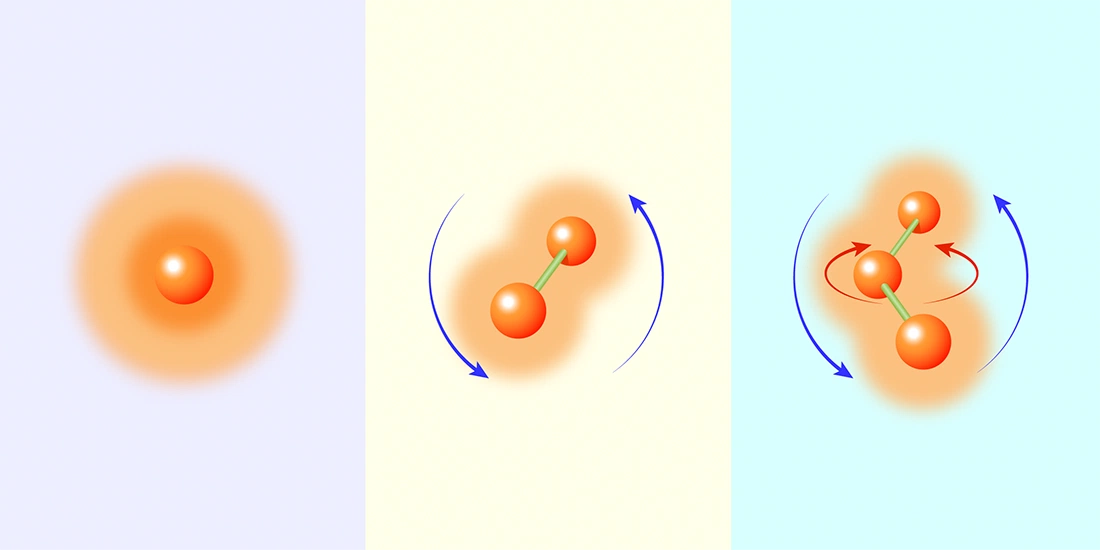
Ultracold gases have been a cornerstone of modern physics, advancing fundamental physics, quantum simulation, quantum computation, atomic clocks, and quantum sensing. Recently, the family of ultracold gases has expanded to include diatomic molecules made of two atomic species. Their additional degrees of freedom of vibration and rotation add experimental complexity, while their unique features, such as strong dipolar interactions, expand their scientific scope far beyond ultracold atoms. Polyatomic molecules—those with three or more atoms—are the next frontier. Although they require control over more vibrational and rotational modes, they have properties that can be exploited to build the next generation of fundamental physics sensors, quantum computers, and simulators [1, 2]. Christian Hallas and Nathaniel Vilas from Harvard University and their colleagues have shown that they can trap polyatomic molecules at high densities and ultracold temperatures, enabling them to observe and control collisions between these molecules [3, 4]. These are important milestones toward creating gases of polyatomic molecules that are dense enough to unleash their full quantum nature.